By James J. Gormley
Courtesy of American Chronicle
On August 23rd, Verizon's lobbyist Tom Tauke gave a speech at a trade forum sponsored by the Information Technology Industry Council (ITI) where he, according to Free Press, defended his company's recent net neutrality pact with Google.
According to FreePress.net, "Tauke claimed that the two companies proposal fulfills the president's campaign promise of non-discrimination and transparency on the Internet, but the pact," said Free Press, would exclude all wireless internet connections, and would even bar the Federal Communications Commission (FCC) from "having any authority to make and enforce net neutrality rules, instead requiring it to defer to a third-party industry group."
"Verizon is simply dead wrong in claiming their farce of a framework would fulfill President Obama's net neutrality promises," said Free Press research director S. Derek Turner in a statement. "Verizon can't hide the fact that, if enacted, this pact would mark the end of the open Internet era."
"The Google-Verizon deal contains no protections for wireless access, which accounts for nearly one-third of all Internet connections, giving Verizon and other ISPs [internet service providers] the green light to block or degrade content on their wireless networks," added Turner. "In addition, it would allow internet service providers to discriminate online by offering private Internet services alongside those on the 'public' Internet. As a candidate, Obama himself opposed the two-tiered Internet this proposal would create."
"The simple fact is Verizon and Google cooked this scheme to carve up the Internet among themselves and other industry giants because they fear competition on the free and open internet," Turner said in conclusion. "It's up to [FCC] Chairman Genachowski and the FCC, not Verizon or Google, to fulfill President Obama's promises to preserve net neutrality."
Other groups criticized the new talks, as well. Instead of more industry discussions, the FCC should move to pass formal net neutrality rules, said Andrew Jay Schwartzman, senior vice president and policy director at the Media Access Project, in the August 24th edition of CIO in an article by Grant Gross. "FCC chairman Julius Genachowski has pushed for formal net neutrality rules after an appeals court in April struck down the agency's attempt to enforce informal principles after Comcast (CMCSA) slowed customers' access to a peer-to-peer service," Gross wrote.
All somewhat puzzling given this statement by Google's Eric Schmidt way back in 2006:
"The Internet as we know it is facing a serious threat. There's a debate heating up in Washington, DC on something called 'net neutrality' – and it's a debate that's so important Google is asking you to get involved. We're asking you to take action to protect Internet freedom. In the next few days, the House of Representatives is going to vote on a bill that would fundamentally alter the Internet. That bill, and one that may come up for a key vote in the Senate in the next few weeks, would give the big phone and cable companies the power to pick and choose what you will be able to see and do on the internet.[...]
"Today the Internet is an information highway where anybody – no matter how large or small, how traditional or unconventional – has equal access. But the phone and cable monopolies, who control almost all Internet access, want the power to choose who gets access to high-speed lanes and whose content gets seen first and fastest. They want to build a two-tiered system and block the on-ramps for those who can't pay."
It would be hard to disagree with what Google said in 2006, although consumer advocates are rightly concerned that in August 2010 Google and Verizon have just drafted a "new policy framework" on net neutrality that would support an "almost free" internet in which wired broadban would be free whereas wireless – the real future of the internet – would not be free.
According to Anthony Carranza in the Examiner.com, "Among those who strongly criticized this proposal was Senator Al Franken when he summed up that the maneuvers from these major corporations such as Google and Verizon are going to trample the first amendment of the constitution since it would oppress freedom of expression online."
Video from Sen. Franken's talk can be found here:
http://www.youtube.com/watch?v=hjYpz5TQSlE&feature=player_embedded
It is time for Americans who want net neutrality to speak up and tell the FCC what it needs, which is to support President Obama's vision of a truly free, not an almost free, internet.
On or before September 20, 2010, consumers can file comments on the FCC web site in reference to "WC Docket No. 09-197." According to the FCC, comments may be filed using the Commission´s Electronic Comment Filing System (ECFS) or by filing paper copies. Comments may be filed electronically using the Internet by accessing the ECFS.
And remember, those who wish to support a free internet should consider denying the request of internet wireless (i-wireless) to be exempt from (or to "forbear from") the net neutrality freedoms that the rest of the internet would have.
Those who wish an almost free internet, well you know what to do – just visit those corporate sites to find out.
Saturday, August 21, 2010


Friday, August 20, 2010
Consumer Reports Gets It Wrong Again (Even with AHPA’s Help)
Courtesy of AHPA
When Consumer Reports (CR) first identified its “Dirty Dozen” dietary supplement ingredients in 2004, the media became very excited and reported broadly on this “news” and its catchy moniker. But there were a lot of problems with the list, and AHPA’s Steven Dentali, Ph.D. submitted a letter to the editor to provide some clarity:
But apparently the tagline was too good to give up, so this year’s “Dirty Dozen,” just reissued in its September edition, has been repopulated with six other ingredients that again betray a lack of expertise. The four new herbs on the list are aconite, country mallow (Sida cordifolia), greater celandine (Chelidonium majus) and coltsfoot (Tussilago farfara).
As Matt Lauer said on the Today Show while interviewing Nancy Metcalf, CR’s Senior Program Editor on August 3rd: “I haven’t heard of most of these things.”
But even though these herbs might not be on the tip of everyone’s tongue or be key marketplace ingredients (Mark Brush at Nutrition Business Journal issued “A Response to Consumer Reports’ Scary Supplements” yesterday and provided figures that estimate the cumulative sales of these 12 ingredients as ~0.2 percent of the annual supplement market), Dr. Dentali offers the following thoughts:
Much of this article is focused on individuals who suffered significant adverse events when taking products labeled as dietary supplements. These include one unfortunate man who took a product found to be laced with a synthetic steroid, and another who suffered from a product found to contain 200 times as much selenium as was stated on its label. But the first of these products was an illegal drug, and not a dietary supplement, and the second failed to comply with good manufacturing practice, and so was adulterated.
“Consumer Reports is attempting to draw broad conclusions about the regulation of dietary supplements based on anecdotes related to products that do not represent the mainstream,” noted Michael McGuffin, AHPA President. “This tone is unfortunate and misses an opportunity to express support for the efforts of responsible industry players to improve enforcement of the good laws already in place.”
When Consumer Reports (CR) first identified its “Dirty Dozen” dietary supplement ingredients in 2004, the media became very excited and reported broadly on this “news” and its catchy moniker. But there were a lot of problems with the list, and AHPA’s Steven Dentali, Ph.D. submitted a letter to the editor to provide some clarity:
- FDA had already forbidden the sale of herbs that contain aristolochic acid in the U.S. This was included on that 2004 list, as the only “definitely hazardous” material.
- It was wrong to say that skullcap (Scutellaria lateriflora) damages the liver, when it had been well established that case reports suggesting such effects should be attributed to adulteration with germander (Teucrium chamaedrys), which was not meaningfully present in the marketplace. Both skullcap and germander were on the 2004 list.
- The issue with pennyroyal (Hedeoma pulegioides) is related to internal use of the essential oil, not the herb itself. And while it was the oil that CR included in its “dozen,” only products made from the herb were identified.
- Federal regulators had acted as early as 2001 to remove comfrey (Symphytum officinale) from the market when offered for sale for internal use.
But apparently the tagline was too good to give up, so this year’s “Dirty Dozen,” just reissued in its September edition, has been repopulated with six other ingredients that again betray a lack of expertise. The four new herbs on the list are aconite, country mallow (Sida cordifolia), greater celandine (Chelidonium majus) and coltsfoot (Tussilago farfara).
As Matt Lauer said on the Today Show while interviewing Nancy Metcalf, CR’s Senior Program Editor on August 3rd: “I haven’t heard of most of these things.”
But even though these herbs might not be on the tip of everyone’s tongue or be key marketplace ingredients (Mark Brush at Nutrition Business Journal issued “A Response to Consumer Reports’ Scary Supplements” yesterday and provided figures that estimate the cumulative sales of these 12 ingredients as ~0.2 percent of the annual supplement market), Dr. Dentali offers the following thoughts:
- Aconite: In the U.S. aconite is primarily available as a homeopathic medicine, which has not been associated with any of the potentially toxic constituents in the plant itself. AHPA recommends that aconite root be excluded as an ingredient from dietary supplements available for retail sale.
- Coltsfoot: AHPA has recommended since 1996 against the oral use of any herb that contains toxic pyrrolizidine alkaloids – including coltsfoot and also comfrey, which was retained by CR from its 2004 list. The Food and Drug Administration declared in 2001 that it considers any product for oral use that contains toxic pyrrolizidine alkaloids to be adulterated, and the Federal Trade Commission has also acted against the sale of such products.
- Sida cordifolia: CR has identified a concern about “country mallow” based on “possible dangers linked with its ephedrine alkaloids.” If there is any ephedrine in Sida cordifolia, however (recent research suggests that there is not), it is present only at a very low level, less that 0.1 percent. And if this herb was, in fact, providing ephedrine it would not be legal to use in a dietary supplement.
- Several of the other herbs that were identified in both 2004 and CR’s current list are labeled to inform consumers of safety issues material to their use. For example, AHPA maintains a labeling policy for kava (Piper methysticum) that provides information that is consistent with FDA’s 2002 Consumer Advisory on this herb. And chaparral (Larrea tridentata), lobelia (Lobelia inflata), and yohimbe (Pausinystalia johimbe) are all classified by AHPA’s Botanical Safety Handbook in categories that identify specific cautions.
Consumers Union, the publisher of Consumer Reports, describes itself as an organization that was founded in part because consumers “lacked a reliable source of information they could depend on to help them distinguish hype from fact.” Unfortunately, the article that accompanies their new list (Anon. September 2010. Dangerous supplements. What you don’t know about these 12 supplements could hurt you. Consumer Reports) strays into sensationalism.
Much of this article is focused on individuals who suffered significant adverse events when taking products labeled as dietary supplements. These include one unfortunate man who took a product found to be laced with a synthetic steroid, and another who suffered from a product found to contain 200 times as much selenium as was stated on its label. But the first of these products was an illegal drug, and not a dietary supplement, and the second failed to comply with good manufacturing practice, and so was adulterated.
“Consumer Reports is attempting to draw broad conclusions about the regulation of dietary supplements based on anecdotes related to products that do not represent the mainstream,” noted Michael McGuffin, AHPA President. “This tone is unfortunate and misses an opportunity to express support for the efforts of responsible industry players to improve enforcement of the good laws already in place.”
Tuesday, April 13, 2010
Timeline of the Natural Products Industry
By James J. Gormley
Ever wonder how we got here? Well, NOW Foods asked me to draft a timeline of the natural products industry---which I am happy to share with the natural products/health-food industry and consumers, The Gormley Files readers and NOW Foods Health E-News subscribers. Please let me know what major milestones are missing (or edits are needed) and I will be happy to include in updated versions of this document.
 1790s
Thomsonianism (a form of herbalism) is developed by Samuel Thomson, a New Hampshire farmer.
1812-1870s
Early OTC (over the counter) drug forerunners, patent medicines, are in their heyday in the U.S. with mercury-laced concoctions, such as Swaim’s Panacea.

1820s-1830s
Homeopathy is established in the U.S.
1820s
In the late 1820s, Eclecticism (similar to naturopathy) is started by New Yorker Wooster Beach.
 1840s
Father Sebastian Kneipp’s “water cure” and herbal remedies become popular in the U.S.
1859
Florence Nightingale writes: “Nature alone cures […] What nursing has to do is put the patient in the best condition for nature to act upon him.”
1870s
Mary Baker Eddy, the foundress of Christian Science, is greatly influenced by the “magnetic healing” (or Mesmerism) of Austrian physician Franz Mesmer.
Osteopathy (originally a system of musculoskeletal manipulation) is begun by Andrew Taylor Still; his osteopathic school is opened in 1892, today called A.T. Still University (ATSU).
1890s
The nutritional integrity of the American food supply is devastated as millers begin using “sophisticated refining machinery [that] remove the germ and many vitamins and minerals from wheat and other whole grains and produce glistening, nutritionally inadequate white flour,” according to Frank Murray in More Than One Slingshot (1984).
1895
Iowan Daniel David Palmer discovers and describes chiropractic manipulation, the year the first chiropractic school opened.
 1896
After 1896, Benedict Lust, founds American naturopathy in the U.S., initially to popularize Fr. Kneipp’s hydropathy, which had faded after the Civil War. Lust blends manipulation procedures with hydropathic treatments, herbal remedies and other natural approaches.
1896-1938
The country’s first health-food stores emerge.
1900
Twenty percent of all doctors are alternative physicians: there are 10,000 homeopaths, 5,000 Eclectics, 5,000 other holistic physicians and 100,000 allopaths.
 1910-1930
The American Medical Association (AMA) and a lobby of early “modern” pharmacies are embarrassed by the Flexner Report of 1910 (which made disease-focused, or allopathic, medicine look bad) and work together to mainly run natural medicine “out of town,” focusing especially on Eclectic, naturopathic and homeopathic medical schools. By 1930, aside from osteopathic and chiropractic schools, alternative medicine has been dealt a severe blow.
1936
By 1936, Chicago baker, Anthony Berhalter, organizes a group of retailers and suppliers to meet in Chicago to form the American Health Foods Association (AHFA).
 1937
Chicago’s 1937 convention is held at the old Auditorium Hotel and consisted of 15 booths, and includes: Tam Products (today called American Health); Elam Mills; Battle Creek Scientific Foods; H.W. Walker Inc.; and Modern Diet Products.
 1938
The first industry trade magazine, Health Foods Retailing, begins publication.
The AHFA is re-named the National Health Foods Association (NHFA), whose first officers included such industry leaders as Paul Bragg and Lelord Kordell. The newly re-named association’s first convention is held at Chicago’s Sherman Hotel and attracts more than 1,000 consumers and industry members.
The Federal Food Drug and Cosmetic Act is enacted, mainly in response to deaths from the drug, Elixir Sulfanilamide.
 Better Nutrition magazine is first published by the same company that began Health Foods Retailing.
Congress passes the Food Drug and Cosmetic (FDC) Act, which is the first regulation to establish labeling requirements and daily minimum levels for several vitamins and minerals.
1943
The NHFA becomes the National Dietary Foods Association (NDFA).
1946
The NDFA holds its convention at Chicago’s Hotel Continental.
1951
The NDFA’s annual convention is held at Detroit’s Hotel Book-Cadillac and showcases nearly 100 exhibitors and over 300 attendees.
1953
At a pharmacists’ convention in Philadelphia, attendees vote to push for legislation making all vitamins, minerals and food supplements available only in drug stores, a move fought against vigorously by the health-food movement.
1955
The natural products industry forms the Public Relations, Education, Legal, Legislation and Lobbying program (PELL) to counter attacks against the health-food industry in the media and in legislation.

Adelle Davis, a nutritional pioneer who would author several influential books on nutrition, addresses the industry for the first time.
1957
It is reported that a Minnesota law requiring vitamins to be sold in pharmacies has been overturned; vitamins can now be sold in any food store in that state.
1958
Regional health food associations have grown by now, including: Northern California Nutritional Foods Retailers Association, the Southern California Nutritional Association and the Northwest Dietary Foods Association, which convene together to hold the West Coast Dietary Foods Fair in Portland, Oregon.
The Food Additives Amendment to the FDC is passed. It includes restrictive provisions, such as prohibiting the use of several minerals in supplement preparations.
1960
 In December, government agents enter the warehouses of the Balanced Foods Company in New York City and seize many copies of Folk Medicine and Arthritis and Folk Medicine, two popular books by the late doctor, D.C. Jarvis. The agents also seize bottles of vinegar and honey, since they were referred to in Jarvis’ books. The FDA brought suit against Balanced Foods in Federal District Court in New York City on the grounds that the vinegar and honey products constituted “misbranded drugs”! Milton Bass won this case … for consumers and the industry.
 Dr. Carlton Fredericks’ Eat, Live and Be Merry is published.
1961
During a 1961 FDA inspection of American Health (then American Dietaids), a hidden tape recorder carried by an inspector malfunctions, revealing its presence to company officials.
This practice continued, however, and would later be acknowledged in sworn testimony at a Senate subcommittee hearing on Administrative Practice and Procedure in 1965.
1962
At its annual convention, the NDFA warns its members of the threat posed by proposed FDA regulations that would severely harm the health-food industry. The law firm of Bass and Friend, headed by industry advocate Milton Bass, is hired to represent the NDFA and the industry.
 Niacin Therapy in Psychiatry by Dr. Abram Hoffer is published.
Silent Spring by Rachel Carson, a book credited with singlehandedly launching the environmental movement, is published.
1963
The Codex Alimentarius Commission (CAC) is officially created in 1963 by the Food and Agriculture Organization (FAO) and World Health Organization (WHO) to “develop food standards, guidelines and related texts such as codes of practice.” The main purposes of this commission are said to be: “protecting health of the consumers,” “ensuring fair trade practices in the food trade” and “promoting coordination of all food standards.”
1965
Dr. Carlton Fredericks’ Low-Carbohydrate Diet is published.
1966
On June 18th, the U.S. Food and Drug Administration (FDA) announces that it is going to ban nutrient potencies above 100% of the RDAs by classifying the over-100% products as drugs. The FDA also announces labeling restrictions that would have forbidden the inclusion of any useful information on dietary supplements.
The proposed regulations are called “The Vitamin Volstead Act” by the health-food industry since they would have served as a 1966 version of Prohibition, in this case in reference to dietary supplements.
A massive industry and consumer battle begins in August, including a postcard campaign and a full-page ad in The Washington Post. American consumers, led by Congressman David King of Utah and the NDFA, ultimately beat it but it would keep resurfacing in various forms for the next 10 years.
 J.I. Rodale’s The Complete Book of Vitamins is published.
1969
The FDA publishes proposed regulations for labeling and content of dietary supplements, however public opposition forces further hearings that last until the early 1970s.
The NHFA merges with the American Dietary Retailers Association (NDRA) and is now called the National Nutritional Foods Association (NNFA), which is announced at the 1970 show.
 1970
The Chemical Feast: Ralph Nader’s Study Group Report on the Food and Drug Administration by James Turner is published.
Seeds of Change, the Green Revolution and Development in the 1970s by Lester R. Brown is published.
1971
Ruth Adams’ Say No! The New Pioneers Guide to Action to Save Our Environment is published.
 1972
Sen. William Proxmire, a long-time health advocate, delivers the keynote address at the NNFA’s convention in Washington, D.C.
Rodale’s Complete Book of Minerals for Health is published.
1973
FDA publishes final regulations classifying any supplements with potencies above 150 percent of the RDAs as drugs.
Senator William Proxmire (D-Wis.) introduces S. 2801, called “The Food Supplement Amendment of 1973,” also called the Proxmire Amendment or the Vitamin Bill (which on the House side was H.R. 643, or the Hosmer Bill). This legislation is designed to prevent the FDA from classifying vitamins and minerals as drugs and to require the agency to regulate vitamins and minerals as foods or food supplements.
In support of H.R. 643, many experts and advocates give testimony, including: Dr. Annette Dickinson, Dr. Carlton Fredericks, Max Huberman, David King, Jim Turner, Esq., and Dr. Roger Williams.
The Council for Responsible Nutrition (CRN) is founded.
Dr. William Crook’s Your Child and Allergy is published.
Dr. Atkins’ Diet Revolution is published.
 1974
Mega-Vitamin Therapy by Abram Hoffer, Frank Murray and Ruth Adams is published.
1975
Supernutrition: Megavitamin Revolution by Dr. Richard Passwater is published.
S. 548 [co-sponsored by Senators William Proxmire and Richard Schweiker (R-Penn.)], The Food Supplement Amendment of 1975, and Congressman William Randall’s H.R. 11247, are introduced to combat H.R. 16317 (an anti-supplement version of the Hosmer Bill), a newer version of the previously defeated Vitamin Volstead Act that would re-classify vitamins with potencies higher than 150 percent of the RDAs as drugs.
1976
On April 22, Pres. Gerald Ford signs the Heart and Lung Act, to which the Proxmire-Schweiker Vitamin Bill had been attached.
The NNFA---along with numerous champions, including Milton Bass, Max Huberman, Frank Murray and many others---fights against the devastating vitamin restrictions and ultimately wins. At the time, Max Huberman and Milton Bass write: “This landmark legislation is the greatest victory for the health food industry and consumer rights ever achieved.”
1978
Orthomolecular Nutrition by Abram Hoffer and Morton Walker is published.
 1979
Cancer and Vitamin C by Drs. Ewan Cameron and Linus Pauling is published.
1980
Crooks’ Tracking Down Hidden Food Allergy is published.
1981
Dr. Atkins’ Nutrition Breakthrough is published.
1982
Brown’s Building A Sustainable Society is published by the Worldwatch Institute.
1983
Crook’s The Yeast Connection is published.
 1984
More Than One Slingshot: How the Health Food Industry Is Changing America by Frank Murray is published by the National Nutritional Foods Association.
1985
Carlton Fredericks’ New Low Blood Sugar and You is published.
1987
Fats That Heal, Fats That Kill by Udo Erasmus is introduced.
1989
Hoffer’s Orthomolecular Medicine for Physicians is published.
1990
President George H.W. Bush signs into law the Nutrition Labeling and Education Act (NLEA), which is intended to improve nutritional information regarding health claims made for products. The FDA is given the responsibility of implementing the law but, because of broad wording, the agency takes advantage of the opportunity to over-regulate nutritional supplements.
 The Real Vitamin and Mineral Book by Dr. Shari Lieberman is published.
Prescription for Nutritional Healing by Phyllis Balch and Dr. James Balch is published.
1991
 Passwater’s The New Supernutrition is published.
Crook’s Help for the Hyperactive Child is published.
Brown’s Saving the Planet: How to Shape An Environmentally Stable Global Economy is published by the Worldwatch Institute.
 1992
The Health Freedom Act (S. 2835) is introduced by Sen. Orrin Hatch (R-Utah), legislation to protect the rights of American consumers to choose safe and effective dietary supplements. The basic principle of the bill was that supplements are not food additives, they aren’t drugs and they need to be defined.
The FDA had been using the food additives provisions in the law to go after supplements it did not like. In fact, in the early 1990s the FDA went on an enforcement rampage.
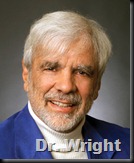 On May 6th, in what is today remembered as the Tahoma Clinic Raid, the FDA stormed Dr. Jonathan Wright’s clinic with armed sheriffs who terrorized patients and seized vitamins, equipment and medical records. Fear of similar abuse of power spread like wildfire across the U.S.
Joe Bassett and the northwest region of the NNFA expanded an early incarnation of Citizens for Health (CFH) in order to mobilize consumers and health-food stores against these threats.
Along with Bassett were Jim Golick, Margaret Isely, Bonnie Minsky, Dr. Joan Priestley, Alex Schauss, Craig Winters and others.
1993
Meanwhile, industry champions such as Loren Israelsen, Milton Bass, Scott Bass (son of Milton Bass), Hal Drexler (of Country Life), Jarrow Rogovin (of Jarrow Formulas) and many others, were devoting considerable resources to the battle for DSHEA up to (and past) the 11th hour.
 A dramatic public-service ad (PSA) was developed by director, Charles Abehsera, and aired nationally in December. In the ad, federal agents equipped in full Special Forces gear, including night vision and weapons, converge on Mel Gibson, in this now-famous cameo, who says, in defense as he holds up a supplement bottle: “Hey. Guys. Guys. It’s only vitamins.”
1994
Although the Democrats had a majority in the House and Senate, indicators were that the party was in danger of losing a number of seats in the 1994 election and the Democratic leadership was not eager to look like bad guys to the millions of Americans who supported the Hatch-Harkin-Richardson Bill (DSHEA), or S. 784.
 Over the course of several hours, Senators Hatch, Kennedy, Harkin, Waxman and Congressman Dingell were able to hammer out a compromise bill. Between August 13 and October, both the Senate and House versions of DSHEA passed. Passage of DSHEA creates a new framework for regulation of dietary supplements.
At the time, Sen. Orrin Hatch comments: “I want to cite the dedicated efforts of Citizens for Health, whose thousands of members have worked tirelessly and unselfishly to make this an informed and successful debate. There is no question in my mind that the work of this citizen army makes today’s victory possible.”
Tales of A Shaman’s Apprentice by Dr. Mark J. Plotkin is published.
1995
Crook's The Yeast Connection and the Woman is published.
1996
The White House Commission on Dietary Supplement Labels issues its report on future regulation of this product category.
Hoffer’s Laws of Natural Nutrition is published.
1997
The USDA proposes its first version of Organic standards late this year. The CCOF, the Organic Trade Association and Citizens for Health are able to stop the U.S. Department of Agriculture (USDA) from debasing the definition of “organic.” Over a period of several months (into early 1998), nearly 300,000 communications were directed to the USDA protesting the proposal. The Secretary of Agriculture says, at the time, that this was the largest number of comments the Department has ever received on any proposed regulation. The FDA publishes industry regulations for structure/function claims that appear on supplement packaging and marketing materials.
Congress includes in the Food and Drug Modernization Act a provision allowing dietary supplements to make health claims.
Food Pets Die For (an exposé of the pet foods industry) is published by Ann N. Martin.
A second edition of Prescription for Nutritional Healing by Dr. James Balch and Phyllis Balch is introduced.
1998
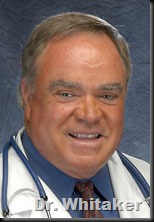
FDA inspectors arrive at the offices of a Texas-based stevia company to "witness destruction" of "offending" cookbooks featuring stevia, and other literature. A video camera taping the aborted destruction, and the intercession of Julian Whitaker, M.D. and Jim Turner prevented the book burning.
1999
The landmark case, Pearson v. Shalala (see related decision in 2001), was won, which finally forced the FDA to allow qualified health claims.
In March 1999, consumer and industry advocates successfully testify on Capitol Hill to oppose the FDA’s proposal to redefine disease to include life stages and normal discomforts, such as pregnancy, aging, menopause and headache.
FDA regulations require that a Supplement Facts panel appear on dietary supplement labels.
The NNFA rolls out a Good Manufacturing Practices (GMPs) program.
 The Green Pharmacy by Dr. James Duke is published.
2000
Dr. Duke’s Essential Herbs is published.
2002
Dr. Atkins’ New Diet Revolution is published.
2004
Healing Cancer: Complementary Vitamin and Drug Treatments by Drs. Abram Hoffer and Linus Pauling is published.
2005
Despite a worldwide consumer backlash, Codex’ Draft Guidelines for Vitamin and Mineral Food Supplements are ratified and the European Food Supplements Directive (EFSD) is put in place.
2006
Largely thanks to several thousand letters sent to legislators through a consumer-industry coalition supporting its passage, the “AER bill” (The Dietary Supplement and Nonprescription Drug Consumer Protection Act”) clears through the U.S. House of Representatives at 3:06 am on December 9th, 2006.
2007
The FDA’s issues guidance on complementary and alternative medicine that could open the door to re-classifying common herbs and fruit/vegetable juices as “drugs” depending on their intended use. This is successfully opposed by Citizens for Health and many other advocacy organizations.
2008
In June, a three-year roll-out of the Federal cGMPs (current GMPs) for dietary supplements begins.
On April 17th, the FDA receives a Citizen Petition from a pharmaceutical company demanding that all weight-loss support claims be re-classified as disease claims, which was strongly condemned by consumers and natural products industry organizations.
 Emord’s The Rise of Tyranny: How Federal Agencies Abuse Power and Pose Risks to Your Life and Liberty is published.
2009
In March, S. 510, the Food Safety Bill, is introduced by Sen. Richard Durbin (D-Ill.). Many consumer advocates and industry experts point out that S. 510 (which would cost Americans $825 billion in 2010 alone) and the House of Representatives version of this bill, H.R. 2749, which passed under suspended rules, do not address the root causes of the U.S.'s food safety problems and would hurt small growers and retailers.
2010
S. 3002, the Dietary Supplement Safety Act of 2010, is introduced by Sen. John McCain (R-Ariz.). Drafted to mainly address problems relating to athletes’ use of products spiked with drugs and illegal substances, the bill would do nothing to protect athletes or sports and would hurt health-food retailers, legitimate supplement makers and the American public without solving any problems.
After a massive grassroots letter-writing campaign led by Citizens for Health, the Alliance for Natural Health, and the Natural Products Association, on March 4th, Sen. Hatch submits a letter to Sen. McCain thanking him for withdrawing his support for parts of S. 3002.
On March 9th, Senators McCain and Dorgan submit a letter to Senators Harkin, Enzi and Hatch pledging to work with them in incorporating common-ground provisions into S. 510 (the Food Safety bill).
Dietary supplement cGMPs are now in place.
Brown’s World on the Edge: How to Prevent Environmental and Economic Collapse is published.
Ever wonder how we got here? Well, NOW Foods asked me to draft a timeline of the natural products industry---which I am happy to share with the natural products/health-food industry and consumers, The Gormley Files readers and NOW Foods Health E-News subscribers. Please let me know what major milestones are missing (or edits are needed) and I will be happy to include in updated versions of this document.
 1790s
Thomsonianism (a form of herbalism) is developed by Samuel Thomson, a New Hampshire farmer.
1812-1870s
Early OTC (over the counter) drug forerunners, patent medicines, are in their heyday in the U.S. with mercury-laced concoctions, such as Swaim’s Panacea.

1820s-1830s
Homeopathy is established in the U.S.
1820s
In the late 1820s, Eclecticism (similar to naturopathy) is started by New Yorker Wooster Beach.
 1840s
Father Sebastian Kneipp’s “water cure” and herbal remedies become popular in the U.S.
1859
Florence Nightingale writes: “Nature alone cures […] What nursing has to do is put the patient in the best condition for nature to act upon him.”
1870s
Mary Baker Eddy, the foundress of Christian Science, is greatly influenced by the “magnetic healing” (or Mesmerism) of Austrian physician Franz Mesmer.
Osteopathy (originally a system of musculoskeletal manipulation) is begun by Andrew Taylor Still; his osteopathic school is opened in 1892, today called A.T. Still University (ATSU).
1890s
The nutritional integrity of the American food supply is devastated as millers begin using “sophisticated refining machinery [that] remove the germ and many vitamins and minerals from wheat and other whole grains and produce glistening, nutritionally inadequate white flour,” according to Frank Murray in More Than One Slingshot (1984).
1895
Iowan Daniel David Palmer discovers and describes chiropractic manipulation, the year the first chiropractic school opened.
 1896
After 1896, Benedict Lust, founds American naturopathy in the U.S., initially to popularize Fr. Kneipp’s hydropathy, which had faded after the Civil War. Lust blends manipulation procedures with hydropathic treatments, herbal remedies and other natural approaches.
1896-1938
The country’s first health-food stores emerge.
1900
Twenty percent of all doctors are alternative physicians: there are 10,000 homeopaths, 5,000 Eclectics, 5,000 other holistic physicians and 100,000 allopaths.
 1910-1930
The American Medical Association (AMA) and a lobby of early “modern” pharmacies are embarrassed by the Flexner Report of 1910 (which made disease-focused, or allopathic, medicine look bad) and work together to mainly run natural medicine “out of town,” focusing especially on Eclectic, naturopathic and homeopathic medical schools. By 1930, aside from osteopathic and chiropractic schools, alternative medicine has been dealt a severe blow.
1936
By 1936, Chicago baker, Anthony Berhalter, organizes a group of retailers and suppliers to meet in Chicago to form the American Health Foods Association (AHFA).
 1937
Chicago’s 1937 convention is held at the old Auditorium Hotel and consisted of 15 booths, and includes: Tam Products (today called American Health); Elam Mills; Battle Creek Scientific Foods; H.W. Walker Inc.; and Modern Diet Products.
 1938
The first industry trade magazine, Health Foods Retailing, begins publication.
The AHFA is re-named the National Health Foods Association (NHFA), whose first officers included such industry leaders as Paul Bragg and Lelord Kordell. The newly re-named association’s first convention is held at Chicago’s Sherman Hotel and attracts more than 1,000 consumers and industry members.
The Federal Food Drug and Cosmetic Act is enacted, mainly in response to deaths from the drug, Elixir Sulfanilamide.
 Better Nutrition magazine is first published by the same company that began Health Foods Retailing.
Congress passes the Food Drug and Cosmetic (FDC) Act, which is the first regulation to establish labeling requirements and daily minimum levels for several vitamins and minerals.
1943
The NHFA becomes the National Dietary Foods Association (NDFA).
1946
The NDFA holds its convention at Chicago’s Hotel Continental.
1951
The NDFA’s annual convention is held at Detroit’s Hotel Book-Cadillac and showcases nearly 100 exhibitors and over 300 attendees.
1953
At a pharmacists’ convention in Philadelphia, attendees vote to push for legislation making all vitamins, minerals and food supplements available only in drug stores, a move fought against vigorously by the health-food movement.
1955
The natural products industry forms the Public Relations, Education, Legal, Legislation and Lobbying program (PELL) to counter attacks against the health-food industry in the media and in legislation.

Adelle Davis, a nutritional pioneer who would author several influential books on nutrition, addresses the industry for the first time.
1957
It is reported that a Minnesota law requiring vitamins to be sold in pharmacies has been overturned; vitamins can now be sold in any food store in that state.
1958
Regional health food associations have grown by now, including: Northern California Nutritional Foods Retailers Association, the Southern California Nutritional Association and the Northwest Dietary Foods Association, which convene together to hold the West Coast Dietary Foods Fair in Portland, Oregon.
The Food Additives Amendment to the FDC is passed. It includes restrictive provisions, such as prohibiting the use of several minerals in supplement preparations.
1960

 Dr. Carlton Fredericks’ Eat, Live and Be Merry is published.
1961
During a 1961 FDA inspection of American Health (then American Dietaids), a hidden tape recorder carried by an inspector malfunctions, revealing its presence to company officials.
This practice continued, however, and would later be acknowledged in sworn testimony at a Senate subcommittee hearing on Administrative Practice and Procedure in 1965.
1962
At its annual convention, the NDFA warns its members of the threat posed by proposed FDA regulations that would severely harm the health-food industry. The law firm of Bass and Friend, headed by industry advocate Milton Bass, is hired to represent the NDFA and the industry.

Silent Spring by Rachel Carson, a book credited with singlehandedly launching the environmental movement, is published.
1963
The Codex Alimentarius Commission (CAC) is officially created in 1963 by the Food and Agriculture Organization (FAO) and World Health Organization (WHO) to “develop food standards, guidelines and related texts such as codes of practice.” The main purposes of this commission are said to be: “protecting health of the consumers,” “ensuring fair trade practices in the food trade” and “promoting coordination of all food standards.”
1965
Dr. Carlton Fredericks’ Low-Carbohydrate Diet is published.
1966
On June 18th, the U.S. Food and Drug Administration (FDA) announces that it is going to ban nutrient potencies above 100% of the RDAs by classifying the over-100% products as drugs. The FDA also announces labeling restrictions that would have forbidden the inclusion of any useful information on dietary supplements.
The proposed regulations are called “The Vitamin Volstead Act” by the health-food industry since they would have served as a 1966 version of Prohibition, in this case in reference to dietary supplements.
A massive industry and consumer battle begins in August, including a postcard campaign and a full-page ad in The Washington Post. American consumers, led by Congressman David King of Utah and the NDFA, ultimately beat it but it would keep resurfacing in various forms for the next 10 years.

1969
The FDA publishes proposed regulations for labeling and content of dietary supplements, however public opposition forces further hearings that last until the early 1970s.
The NHFA merges with the American Dietary Retailers Association (NDRA) and is now called the National Nutritional Foods Association (NNFA), which is announced at the 1970 show.
 1970
The Chemical Feast: Ralph Nader’s Study Group Report on the Food and Drug Administration by James Turner is published.
Seeds of Change, the Green Revolution and Development in the 1970s by Lester R. Brown is published.
1971
Ruth Adams’ Say No! The New Pioneers Guide to Action to Save Our Environment is published.
 1972
Sen. William Proxmire, a long-time health advocate, delivers the keynote address at the NNFA’s convention in Washington, D.C.
Rodale’s Complete Book of Minerals for Health is published.
1973
FDA publishes final regulations classifying any supplements with potencies above 150 percent of the RDAs as drugs.
Senator William Proxmire (D-Wis.) introduces S. 2801, called “The Food Supplement Amendment of 1973,” also called the Proxmire Amendment or the Vitamin Bill (which on the House side was H.R. 643, or the Hosmer Bill). This legislation is designed to prevent the FDA from classifying vitamins and minerals as drugs and to require the agency to regulate vitamins and minerals as foods or food supplements.
In support of H.R. 643, many experts and advocates give testimony, including: Dr. Annette Dickinson, Dr. Carlton Fredericks, Max Huberman, David King, Jim Turner, Esq., and Dr. Roger Williams.
The Council for Responsible Nutrition (CRN) is founded.
Dr. William Crook’s Your Child and Allergy is published.
Dr. Atkins’ Diet Revolution is published.
 1974
Mega-Vitamin Therapy by Abram Hoffer, Frank Murray and Ruth Adams is published.
1975
Supernutrition: Megavitamin Revolution by Dr. Richard Passwater is published.
S. 548 [co-sponsored by Senators William Proxmire and Richard Schweiker (R-Penn.)], The Food Supplement Amendment of 1975, and Congressman William Randall’s H.R. 11247, are introduced to combat H.R. 16317 (an anti-supplement version of the Hosmer Bill), a newer version of the previously defeated Vitamin Volstead Act that would re-classify vitamins with potencies higher than 150 percent of the RDAs as drugs.
1976
On April 22, Pres. Gerald Ford signs the Heart and Lung Act, to which the Proxmire-Schweiker Vitamin Bill had been attached.
The NNFA---along with numerous champions, including Milton Bass, Max Huberman, Frank Murray and many others---fights against the devastating vitamin restrictions and ultimately wins. At the time, Max Huberman and Milton Bass write: “This landmark legislation is the greatest victory for the health food industry and consumer rights ever achieved.”
1978
Orthomolecular Nutrition by Abram Hoffer and Morton Walker is published.
 1979
Cancer and Vitamin C by Drs. Ewan Cameron and Linus Pauling is published.
1980
Crooks’ Tracking Down Hidden Food Allergy is published.
1981
Dr. Atkins’ Nutrition Breakthrough is published.
1982
Brown’s Building A Sustainable Society is published by the Worldwatch Institute.
1983
Crook’s The Yeast Connection is published.
 1984
More Than One Slingshot: How the Health Food Industry Is Changing America by Frank Murray is published by the National Nutritional Foods Association.
1985
Carlton Fredericks’ New Low Blood Sugar and You is published.
1987
Fats That Heal, Fats That Kill by Udo Erasmus is introduced.
1989
Hoffer’s Orthomolecular Medicine for Physicians is published.
1990
President George H.W. Bush signs into law the Nutrition Labeling and Education Act (NLEA), which is intended to improve nutritional information regarding health claims made for products. The FDA is given the responsibility of implementing the law but, because of broad wording, the agency takes advantage of the opportunity to over-regulate nutritional supplements.
 The Real Vitamin and Mineral Book by Dr. Shari Lieberman is published.
Prescription for Nutritional Healing by Phyllis Balch and Dr. James Balch is published.
1991
 Passwater’s The New Supernutrition is published.
Crook’s Help for the Hyperactive Child is published.
Brown’s Saving the Planet: How to Shape An Environmentally Stable Global Economy is published by the Worldwatch Institute.
 1992
The Health Freedom Act (S. 2835) is introduced by Sen. Orrin Hatch (R-Utah), legislation to protect the rights of American consumers to choose safe and effective dietary supplements. The basic principle of the bill was that supplements are not food additives, they aren’t drugs and they need to be defined.
The FDA had been using the food additives provisions in the law to go after supplements it did not like. In fact, in the early 1990s the FDA went on an enforcement rampage.
 On May 6th, in what is today remembered as the Tahoma Clinic Raid, the FDA stormed Dr. Jonathan Wright’s clinic with armed sheriffs who terrorized patients and seized vitamins, equipment and medical records. Fear of similar abuse of power spread like wildfire across the U.S.
Joe Bassett and the northwest region of the NNFA expanded an early incarnation of Citizens for Health (CFH) in order to mobilize consumers and health-food stores against these threats.
Along with Bassett were Jim Golick, Margaret Isely, Bonnie Minsky, Dr. Joan Priestley, Alex Schauss, Craig Winters and others.
1993
Meanwhile, industry champions such as Loren Israelsen, Milton Bass, Scott Bass (son of Milton Bass), Hal Drexler (of Country Life), Jarrow Rogovin (of Jarrow Formulas) and many others, were devoting considerable resources to the battle for DSHEA up to (and past) the 11th hour.
 A dramatic public-service ad (PSA) was developed by director, Charles Abehsera, and aired nationally in December. In the ad, federal agents equipped in full Special Forces gear, including night vision and weapons, converge on Mel Gibson, in this now-famous cameo, who says, in defense as he holds up a supplement bottle: “Hey. Guys. Guys. It’s only vitamins.”
1994
Although the Democrats had a majority in the House and Senate, indicators were that the party was in danger of losing a number of seats in the 1994 election and the Democratic leadership was not eager to look like bad guys to the millions of Americans who supported the Hatch-Harkin-Richardson Bill (DSHEA), or S. 784.
 Over the course of several hours, Senators Hatch, Kennedy, Harkin, Waxman and Congressman Dingell were able to hammer out a compromise bill. Between August 13 and October, both the Senate and House versions of DSHEA passed. Passage of DSHEA creates a new framework for regulation of dietary supplements.
At the time, Sen. Orrin Hatch comments: “I want to cite the dedicated efforts of Citizens for Health, whose thousands of members have worked tirelessly and unselfishly to make this an informed and successful debate. There is no question in my mind that the work of this citizen army makes today’s victory possible.”
Tales of A Shaman’s Apprentice by Dr. Mark J. Plotkin is published.
1995
Crook's The Yeast Connection and the Woman is published.
1996
The White House Commission on Dietary Supplement Labels issues its report on future regulation of this product category.
Hoffer’s Laws of Natural Nutrition is published.
1997
The USDA proposes its first version of Organic standards late this year. The CCOF, the Organic Trade Association and Citizens for Health are able to stop the U.S. Department of Agriculture (USDA) from debasing the definition of “organic.” Over a period of several months (into early 1998), nearly 300,000 communications were directed to the USDA protesting the proposal. The Secretary of Agriculture says, at the time, that this was the largest number of comments the Department has ever received on any proposed regulation. The FDA publishes industry regulations for structure/function claims that appear on supplement packaging and marketing materials.
Congress includes in the Food and Drug Modernization Act a provision allowing dietary supplements to make health claims.
Food Pets Die For (an exposé of the pet foods industry) is published by Ann N. Martin.
A second edition of Prescription for Nutritional Healing by Dr. James Balch and Phyllis Balch is introduced.

1998
FDA inspectors arrive at the offices of a Texas-based stevia company to "witness destruction" of "offending" cookbooks featuring stevia, and other literature. A video camera taping the aborted destruction, and the intercession of Julian Whitaker, M.D. and Jim Turner prevented the book burning.
1999
The landmark case, Pearson v. Shalala (see related decision in 2001), was won, which finally forced the FDA to allow qualified health claims.
In March 1999, consumer and industry advocates successfully testify on Capitol Hill to oppose the FDA’s proposal to redefine disease to include life stages and normal discomforts, such as pregnancy, aging, menopause and headache.
FDA regulations require that a Supplement Facts panel appear on dietary supplement labels.
The NNFA rolls out a Good Manufacturing Practices (GMPs) program.
 The Green Pharmacy by Dr. James Duke is published.
2000
Dr. Duke’s Essential Herbs is published.
2002
Dr. Atkins’ New Diet Revolution is published.
2004
Healing Cancer: Complementary Vitamin and Drug Treatments by Drs. Abram Hoffer and Linus Pauling is published.
2005
Despite a worldwide consumer backlash, Codex’ Draft Guidelines for Vitamin and Mineral Food Supplements are ratified and the European Food Supplements Directive (EFSD) is put in place.
2006
Largely thanks to several thousand letters sent to legislators through a consumer-industry coalition supporting its passage, the “AER bill” (The Dietary Supplement and Nonprescription Drug Consumer Protection Act”) clears through the U.S. House of Representatives at 3:06 am on December 9th, 2006.
2007
The FDA’s issues guidance on complementary and alternative medicine that could open the door to re-classifying common herbs and fruit/vegetable juices as “drugs” depending on their intended use. This is successfully opposed by Citizens for Health and many other advocacy organizations.
2008
In June, a three-year roll-out of the Federal cGMPs (current GMPs) for dietary supplements begins.
On April 17th, the FDA receives a Citizen Petition from a pharmaceutical company demanding that all weight-loss support claims be re-classified as disease claims, which was strongly condemned by consumers and natural products industry organizations.
 Emord’s The Rise of Tyranny: How Federal Agencies Abuse Power and Pose Risks to Your Life and Liberty is published.
2009
In March, S. 510, the Food Safety Bill, is introduced by Sen. Richard Durbin (D-Ill.). Many consumer advocates and industry experts point out that S. 510 (which would cost Americans $825 billion in 2010 alone) and the House of Representatives version of this bill, H.R. 2749, which passed under suspended rules, do not address the root causes of the U.S.'s food safety problems and would hurt small growers and retailers.
2010
S. 3002, the Dietary Supplement Safety Act of 2010, is introduced by Sen. John McCain (R-Ariz.). Drafted to mainly address problems relating to athletes’ use of products spiked with drugs and illegal substances, the bill would do nothing to protect athletes or sports and would hurt health-food retailers, legitimate supplement makers and the American public without solving any problems.
After a massive grassroots letter-writing campaign led by Citizens for Health, the Alliance for Natural Health, and the Natural Products Association, on March 4th, Sen. Hatch submits a letter to Sen. McCain thanking him for withdrawing his support for parts of S. 3002.
On March 9th, Senators McCain and Dorgan submit a letter to Senators Harkin, Enzi and Hatch pledging to work with them in incorporating common-ground provisions into S. 510 (the Food Safety bill).
Dietary supplement cGMPs are now in place.
Brown’s World on the Edge: How to Prevent Environmental and Economic Collapse is published.
Tuesday, March 30, 2010
Health Freedom Nation: Consumers Take Control
By James J. Gormley
[Courtesy of NOW Foods]
Consumers and the health-food industry may have stopped S. 3002 in its tracks, but S. 510 and other threats to health freedom remain. Nevertheless, a new slate of bills, along with a re-invigorated health-freedom movement, offer new hope for the future.
 Since the health-food movement’s earliest origins in New Hampshire in the 1790s, there have been many champions of health freedom.
The one who immediately springs to mind, at least for me, is Frank Murray, who happened to be my first boss before I became editor of Better Nutrition magazine in 1995.
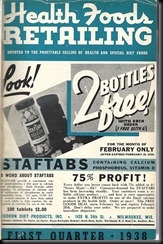 In 2006, Frank was the recipient of the Natural Product Association (NPA) President’s Award for “long-time contributions to the natural products industry.”
He was for many years editor of Health Foods Retailing, the health-food industry’s very first trade publication and the official magazine of the NPA for 50 years, from the late-1930s until the mid-1980s.
More Than One Slingshot
A bestselling health-book author, Frank has been one of the industry’s most articulate, enthusiastic and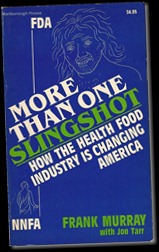 tireless crusaders, having stood arm-in-arm with Milton Bass, Max Huberman and NPA in successful opposition to the Vitamin Volstead Act from 1966 through 1976, when the Proxmire Vitamin Bill was signed into law.
His book, More Than One Slingshot, which was written for the association, tells the history of the health food industry from its origins in the late 1890s up through the early 1980s.
The book has this great, dated cover that I love, one which depicts David and Goliath, a popular representation of the battle between the health-food industry and the U.S. Food and Drug Administration (FDA).
Today, in early 2010, we face many of the same threats to health freedom even if the names of the bills and the players have changed.
Today’s Threats to Health Freedom
In March of 2009, Sen. Richard Durbin (D-IL) introduced S. 510, the Food Safety Modernization Act, a bill that would hand over extensive, unwarranted powers to an agency, the FDA, that has shown that it cannot objectively and properly fulfill its mission regarding dietary supplements since it constantly works to undermine the Dietary Supplement Health and Education Act of 1994 (DSHEA) through coordinated suppression of supplement companies and health information regarding products sold by legitimate manufacturers.
As this bill was reviled by consumers and farmers across the country, it appeared to fall by the wayside, that is until Sen. John McCain introduced S. 3002, the Dietary Supplement Safety Act of 2010.
Senate Bill 3002 was said to be about athletics ─ trying to protect athletes from spiked or doped supplements (although one would think the athletes would know what they were taking, especially if they themselves ordered these products from shifty chemists and fly-by-night pharmacists), but it included a whole host of anti-supplement provisions that almost made S. 510 pale by comparison.
A firestorm of consumer outrage ensued: many tens of thousands of letters were sent to the Senate thanks to powerful grassroots advocacy campaigns organized by Citizens for Health, the Alliance for Natural Health and the NPA. In early March, Sen. McCain decided to withdraw his support of the bill, with the caveat that certain provisions should be carried over to S. 510, most of which are already in S. 510 as it now stands.
Consumers, and the natural products industry, must be especially vigilant now and throughout 2010 ─ regarding S. 510 so that the bad provisions in this bill are dropped or drastically revised, and that nothing even worse from the dry-docked S. 3002 winds up being added to S. 510.
Tomorrow’s Health Freedom Opportunities
As to bills that offer a ray of hope, there are currently three main ones: H.R. 4913, H.R. 3394 and H.R. 3395.
On March 23rd, Rep. Jason Chaffetz (R-Utah) and Rep. Jared Polis (D-CO) introduced the Free Speech about Science Act (H.R. 4913); since then, Rep. Dan Burton (R-Indiana) has signed on as a co-sponsor. The bill allows producers of healthy foods and dietary supplements to cite legitimate scientific studies on the health benefits of their products.
 Similar in title to H.R. 4913, the Freedom of Health Speech Act (H.R. 3394), which was introduced by Rep. Ron Paul on July 29, 2009 and co-sponsored by Rep. Dan Burton and Dana Rohrabacher (R-Calif.), is geared to prevent the FTC from taking action against any advertiser that communicates a health benefit for a product unless the FTC first establishes, based on clear and convincing evidence, that the statement made is false and that its communication causes harm to the public.
 The Health Freedom Act (H.R. 3395) is designed to remove FDA's power of prior restraint over all nutrient-disease relationship claims.
According to Constitutional lawyer Jonathan Emord, under the bill “FDA may not prohibit any statement concerning a nutrient affecting a disease (including treatment effects) from being made in the market and may only act against a statement once made if it possesses clear and convincing evidence that the statement is false.”
Gormley Take-Away: The powerful advocacy campaigns against S. 3002 (which generated tens of thousands of letters), in addition to meetings and conference calls with Sen. McCain and his staff, effected a partial yet still very important victory. The momentum and informed action that allowed consumers and the natural products industry to achieve this win must be maintained so that objectionable provisions of S. 510 are removed or drastically revised. Other bills that offer opportunities for informed action should be kept on our radar screens, including H.R. 4913, H.R. 3394 and H.R. 3395.
[Courtesy of NOW Foods]
Consumers and the health-food industry may have stopped S. 3002 in its tracks, but S. 510 and other threats to health freedom remain. Nevertheless, a new slate of bills, along with a re-invigorated health-freedom movement, offer new hope for the future.
 Since the health-food movement’s earliest origins in New Hampshire in the 1790s, there have been many champions of health freedom.
The one who immediately springs to mind, at least for me, is Frank Murray, who happened to be my first boss before I became editor of Better Nutrition magazine in 1995.
 In 2006, Frank was the recipient of the Natural Product Association (NPA) President’s Award for “long-time contributions to the natural products industry.”
He was for many years editor of Health Foods Retailing, the health-food industry’s very first trade publication and the official magazine of the NPA for 50 years, from the late-1930s until the mid-1980s.
More Than One Slingshot
A bestselling health-book author, Frank has been one of the industry’s most articulate, enthusiastic and
 tireless crusaders, having stood arm-in-arm with Milton Bass, Max Huberman and NPA in successful opposition to the Vitamin Volstead Act from 1966 through 1976, when the Proxmire Vitamin Bill was signed into law.
His book, More Than One Slingshot, which was written for the association, tells the history of the health food industry from its origins in the late 1890s up through the early 1980s.
The book has this great, dated cover that I love, one which depicts David and Goliath, a popular representation of the battle between the health-food industry and the U.S. Food and Drug Administration (FDA).
Today, in early 2010, we face many of the same threats to health freedom even if the names of the bills and the players have changed.
Today’s Threats to Health Freedom
In March of 2009, Sen. Richard Durbin (D-IL) introduced S. 510, the Food Safety Modernization Act, a bill that would hand over extensive, unwarranted powers to an agency, the FDA, that has shown that it cannot objectively and properly fulfill its mission regarding dietary supplements since it constantly works to undermine the Dietary Supplement Health and Education Act of 1994 (DSHEA) through coordinated suppression of supplement companies and health information regarding products sold by legitimate manufacturers.
As this bill was reviled by consumers and farmers across the country, it appeared to fall by the wayside, that is until Sen. John McCain introduced S. 3002, the Dietary Supplement Safety Act of 2010.
Senate Bill 3002 was said to be about athletics ─ trying to protect athletes from spiked or doped supplements (although one would think the athletes would know what they were taking, especially if they themselves ordered these products from shifty chemists and fly-by-night pharmacists), but it included a whole host of anti-supplement provisions that almost made S. 510 pale by comparison.
A firestorm of consumer outrage ensued: many tens of thousands of letters were sent to the Senate thanks to powerful grassroots advocacy campaigns organized by Citizens for Health, the Alliance for Natural Health and the NPA. In early March, Sen. McCain decided to withdraw his support of the bill, with the caveat that certain provisions should be carried over to S. 510, most of which are already in S. 510 as it now stands.
Consumers, and the natural products industry, must be especially vigilant now and throughout 2010 ─ regarding S. 510 so that the bad provisions in this bill are dropped or drastically revised, and that nothing even worse from the dry-docked S. 3002 winds up being added to S. 510.
Tomorrow’s Health Freedom Opportunities
As to bills that offer a ray of hope, there are currently three main ones: H.R. 4913, H.R. 3394 and H.R. 3395.
On March 23rd, Rep. Jason Chaffetz (R-Utah) and Rep. Jared Polis (D-CO) introduced the Free Speech about Science Act (H.R. 4913); since then, Rep. Dan Burton (R-Indiana) has signed on as a co-sponsor. The bill allows producers of healthy foods and dietary supplements to cite legitimate scientific studies on the health benefits of their products.
 Similar in title to H.R. 4913, the Freedom of Health Speech Act (H.R. 3394), which was introduced by Rep. Ron Paul on July 29, 2009 and co-sponsored by Rep. Dan Burton and Dana Rohrabacher (R-Calif.), is geared to prevent the FTC from taking action against any advertiser that communicates a health benefit for a product unless the FTC first establishes, based on clear and convincing evidence, that the statement made is false and that its communication causes harm to the public.
 The Health Freedom Act (H.R. 3395) is designed to remove FDA's power of prior restraint over all nutrient-disease relationship claims.
According to Constitutional lawyer Jonathan Emord, under the bill “FDA may not prohibit any statement concerning a nutrient affecting a disease (including treatment effects) from being made in the market and may only act against a statement once made if it possesses clear and convincing evidence that the statement is false.”
Gormley Take-Away: The powerful advocacy campaigns against S. 3002 (which generated tens of thousands of letters), in addition to meetings and conference calls with Sen. McCain and his staff, effected a partial yet still very important victory. The momentum and informed action that allowed consumers and the natural products industry to achieve this win must be maintained so that objectionable provisions of S. 510 are removed or drastically revised. Other bills that offer opportunities for informed action should be kept on our radar screens, including H.R. 4913, H.R. 3394 and H.R. 3395.
Tuesday, March 09, 2010
Orrin Hatch Letter to John McCain About S. 3002
This letter was sent by Senator Orrin Hatch, senior member of the HELP committee, to Senator John McCain on March 4, 2010, in large part as a result of the massively successful letter-writing campaign initiated by Citizens for Health and several other groups.
Please click here.http://www.citizens.org/?p=1984
Please click here.http://www.citizens.org/?p=1984
Tuesday, February 23, 2010
Anti-Supplement “Perfect” Storm Building in Washington
http://www.citizens.org/?p=1924
By James J. Gormley
As if Senate Bill 3002 (S. 3002) were not more than enough to deal with, according to The Hill Rep. John Dingell (D-Mich.) is criticizing the Senate for not moving on Senate Bill 510 (S. 510).
Unfortunately, The Pew Charitable Trust has been assisting with a coordinated lobbying effort to press Senate leaders to bring the bill to the floor. Sandra Eskin, director of Pew’s food safety campaign, told The Hill that she is “cautiously optimistic” that a vote can occur in the first half of March, before the Senate’s next recess week starts on March 29.
Regan LaChapelle, a spokeswoman for Sen. Harry Reid (D-Nev.), told The Hill that the majority leader hopes to bring the bill to the floor either during the current work period or the next, which runs from April 12 to May 28. “It’s on our list of legislative priorities,” she said. “It could be in March or the next work period. Obviously we have many issues to address.”
House Republicans were split on H.R. 2749, with 54 supporting it and 122 opposed. GOP members who backed it include Reps. Michele Bachmann (Minn.), Joe Barton (Texas), Dave Camp (Mich.) and Greg Walden (Ore.).
After the House bill passed, Rep. Frank Lucas (R-Okla.) told The Washington Post: “The federal government will tell our farmers and ranchers how to do something they’ve been doing since the dawn of mankind. It goes too far in the direction of trying to produce food from a bureaucrat’s chair in Washington, D.C.”
Twenty House Democrats opposed the bill.
Now moreso than in recent memory, it is critical that we all stay tuned to these issues, keeping an eye out for our continuing posts and opportunities for action on S. 3002 and S. 510 — and whatever else floats down the Potomac that threatens DSHEA, our supplements and our health-food stores.
Monday, February 22, 2010
NPA Alerts Health-Food Stores to Dangers of S. 3002
According to the Natural Products Association (NPA) in an e-mail alert issued today, here is how S. 3002 would affect health-food stores:

- All dietary supplements, whether vitamins, minerals, herbal products and others that were previously allowed under DSHEA, could be removed from the market under S. 3002. This legislation would mandate that every dietary supplement would have to go through a brand new process of government review (yet to be defined) in order to remain on store shelves.
- For the first time in the history of food or drug law, retail establishments would need to register with the FDA. Failing to register could result in severe monetary penalties, up to two times your gross profit. Not complying with even minimal technical requirements, such as minor errors in registration, recordkeeping or reporting could be considered a criminal offense.
- Retailers would also be required to obtain “adequate written evidence” from suppliers that each dietary supplement product meets all regulatory requirements. Again, failure to do so could result in severe monetary penalties.

Monday, February 15, 2010
Take Action on S. 3002 Now!
To take action on Senate Bill 3002, please click on the poster below and act now!

Saturday, February 13, 2010
The DEA Should Take Over All Sports Doping Enforcement
By James J. Gormley
In February 2010 in New Orleans, three men were charged by the U.S. Drug Enforcement Administration (DEA) with drug-trafficking Ecstasy, or MDMA (3-4-Methylenedioxymethamphetamine), a synthetic chemical that can be derived from an essential oil of the sassafras tree.

If convicted, the defendants face a possible maximum sentence of 20 years in prison, a $1 million fine and at least three years of supervised release for each count.
MDMA is also one of the easiest illegal drugs to obtain. Its effects are similar to those of amphetamines and hallucinogens. First developed as an appetite suppressant in 1912, MDMA was used as a psychotherapeutic tool and also started to become available on the street is the late 1970s and early 1980s. It wasn’t until 1985 that Ecstasy was made illegal. It is classified as a “Schedule 1” controlled substance along with other narcotics like heroin, cocaine and LSD.
 One reason Ecstasy can be especially dangerous is the lack of content control. Ingredients are hard to get and manufacturers of the drug often use substitutes, mixing other harmful additives with the already dangerous mix. This practice is so common that “drug test kits” are often sold with the drug so users can test for purity.
Because of the uncertainties about the drug sources, pharmacological agents, chemicals used to manufacture them, and possible contaminants, it is difficult to measure the toxicity, consequences and symptoms that might be expected.
Herbal Ecstasy is another form of MDMA that is composed of ephedrine or pseudoephedrine hydrochloride and caffeine from the kola nut. Also sold in tablet form, Herbal Ecstasy can cause permanent brain damage and death. Though not currently classified as a controlled substance, Herbal Ecstasy shares many of the same qualities and effects as MDMA. Also known as Cloud 9, Herbal Bliss, Ritual Spirit, Herbal X, GWM, Rave Energy, Ultimate Xphoria and X.
Anabolic Steroids
Anabolic steroids are synthetically produced versions of the naturally occurring male hormone, testosterone. Both males and females have testosterone produced in their bodies: males in the testes, and females in the ovaries and other tissues. The full name for this class of drugs is androgenic (promoting masculine characteristics) anabolic (tissue building) steroids (the class of drugs).
Some of the common street names for anabolic steroids include: arnolds, gym candy, pumpers, 'roids, stackers, weight trainers and juice. Currently, there are more than 100 different types of anabolic steroids that have been developed, and each requires a prescription to be used legally in the U.S.
Anabolic steroids can be taken orally, injected intramuscularly, or rubbed on the skin when in the form of gels or creams. These drugs are often used in patterns called cycling, which involves taking multiple doses of steroids over a specific period of time, stopping for a period, and starting again. Users also frequently combine several different types of steroids in a process known as stacking. By doing this, users, more properly abusers, believe that the different steroids will interact to produce an effect on muscle size that is greater than the effects of using each drug individually.
Another mode of steroid use is called "pyramiding." With this method abusers slowly escalate steroid use (increasing the number of drugs used at one time and/or the dose and frequency of one or more steroids), reach a peak amount at mid-cycle and gradually taper the dose toward the end of the cycle. The escalation of steroid abuse can vary with different types of training. Bodybuilders and weight lifters tend to escalate their dose to a much higher level than do long distance runners or swimmers.
Legislation and Enforcement
On March 16th 2004, Joseph Rannazzisi, then deputy director of the DEA's Office of Diversion Control, said in testimony before the House Subcommittee on Crime, Terrorism and Homeland Security:
 "The DEA has one mission: to protect the public from dangerous drugs. However, the current law regarding steroids causes regulatory delay, especially with respect to steroids that we know are hormonally, chemically or pharmacologically related to testosterone. Because DEA’s authority extends only to controlled substances, steroids that are not classified as controlled substances continue to fall outside our jurisdiction. H.R. 3866 [The Anabolic Steroid Control Act of 2004 ] will correct this problem."
Well, the Anabolic Steroid Control Act passed in October 2004.

On the bill's passage, one of its sponsors, Sen. Orrin Hatch (R-UT), remarked:
"Under this bill, clever chemists will no longer be able to dodge the law by disguising their chemicals to skirt the legal definition of a steroid. Our bill gives the Drug Enforcement Agency the power to schedule nearly any steroid precursor now or in the future--giving the law flexibility we don't have to play catch-up with every new andro look-alike that comes along."
On September 29, 2009, the DEA's Rannazzsi, now deputy assistant administrator, said this in testimony before the Subcommittee on Crime and Drugs:
"Although DEA does not have the authority to enforce DSHEA [the Dietary Supplement Health and Education Act of 1994], DEA does have statutory authority to investigate incidents involving the illegal manufacture and distribution of anabolic adrenergic steroids in the dietary supplement market. [...] DEA has the authority and responsibility to investigate companies that are marketing products as dietary supplements that are adulterated with controlled substances."
As well the DEA should; if yogurt were suddenly used as a delivery vehicle for sports steroids, would our guardians of public health call for a new law restricting access to yogurt or would increased enforcement and enforcement funding be directed to the DEA to get the job done? The latter, I would think.
If supplements are being adulterated by illegal labs, why then should supplements get a bad rap? Steroids and sports doping is all about unethical pharmacies and illegal labs.
Case in point, in January 2009, a 198-count DEA indictment was unsealed charging 12 pharmacists and pharmacy owners with participating in a conspiracy that dispensed and sold thousands of dosages of anabolic steroids, including powerful veterinary steroids approved for animal use only.
Another case in point: in October 2009 the DEA announced the completion of a 10-month undercover investigation into an illegal anabolic steroid manufacturing ring that led to three arrests. In the raid, agents seized over 500 vials and 1,850 capsules of anabolic steroid pills.
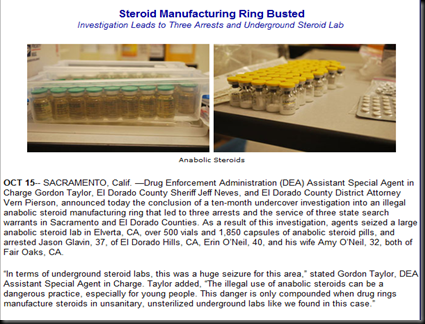
While the U.S. Food and Drug Administration (FDA) has been involved in sweeps relating to the illegal sale of unapproved or misbranded drugs, such as the recent Internet sweep in November 2009 called the "International Internet Week of Action," many observers, including this commentator, strongly believe that all investigation and enforcement of sports doping and illegal steroid distribution and use should immediately be more clearly placed under the aegis of the DEA, as sports doping is not a problem of food products (such as supplements) but a problem of drugs---a problem of dope, pure and simple.
In February 2010 in New Orleans, three men were charged by the U.S. Drug Enforcement Administration (DEA) with drug-trafficking Ecstasy, or MDMA (3-4-Methylenedioxymethamphetamine), a synthetic chemical that can be derived from an essential oil of the sassafras tree.

If convicted, the defendants face a possible maximum sentence of 20 years in prison, a $1 million fine and at least three years of supervised release for each count.
MDMA is also one of the easiest illegal drugs to obtain. Its effects are similar to those of amphetamines and hallucinogens. First developed as an appetite suppressant in 1912, MDMA was used as a psychotherapeutic tool and also started to become available on the street is the late 1970s and early 1980s. It wasn’t until 1985 that Ecstasy was made illegal. It is classified as a “Schedule 1” controlled substance along with other narcotics like heroin, cocaine and LSD.

Because of the uncertainties about the drug sources, pharmacological agents, chemicals used to manufacture them, and possible contaminants, it is difficult to measure the toxicity, consequences and symptoms that might be expected.
Herbal Ecstasy is another form of MDMA that is composed of ephedrine or pseudoephedrine hydrochloride and caffeine from the kola nut. Also sold in tablet form, Herbal Ecstasy can cause permanent brain damage and death. Though not currently classified as a controlled substance, Herbal Ecstasy shares many of the same qualities and effects as MDMA. Also known as Cloud 9, Herbal Bliss, Ritual Spirit, Herbal X, GWM, Rave Energy, Ultimate Xphoria and X.
Anabolic Steroids
Anabolic steroids are synthetically produced versions of the naturally occurring male hormone, testosterone. Both males and females have
 testosterone produced in their bodies: males in the testes, and females in the ovaries and other tissues. The full name for this class of drugs is androgenic (promoting masculine characteristics) anabolic (tissue building) steroids (the class of drugs).
Some of the common street names for anabolic steroids include: arnolds, gym candy, pumpers, 'roids, stackers, weight trainers and juice. Currently, there are more than 100 different types of anabolic steroids that have been developed, and each requires a prescription to be used legally in the U.S.
Anabolic steroids can be taken orally, injected intramuscularly, or rubbed on the skin when in the form of gels or creams. These drugs are often used in patterns called cycling, which involves taking multiple doses of steroids over a specific period of time, stopping for a period, and starting again. Users also frequently combine several different types of steroids in a process known as stacking. By doing this, users, more properly abusers, believe that the different steroids will interact to produce an effect on muscle size that is greater than the effects of using each drug individually.
Another mode of steroid use is called "pyramiding." With this method abusers slowly escalate steroid use (increasing the number of drugs used at one time and/or the dose and frequency of one or more steroids), reach a peak amount at mid-cycle and gradually taper the dose toward the end of the cycle. The escalation of steroid abuse can vary with different types of training. Bodybuilders and weight lifters tend to escalate their dose to a much higher level than do long distance runners or swimmers.
Legislation and Enforcement
On March 16th 2004, Joseph Rannazzisi, then deputy director of the DEA's Office of Diversion Control, said in testimony before the House Subcommittee on Crime, Terrorism and Homeland Security:
 "The DEA has one mission: to protect the public from dangerous drugs. However, the current law regarding steroids causes regulatory delay, especially with respect to steroids that we know are hormonally, chemically or pharmacologically related to testosterone. Because DEA’s authority extends only to controlled substances, steroids that are not classified as controlled substances continue to fall outside our jurisdiction. H.R. 3866 [The Anabolic Steroid Control Act of 2004 ] will correct this problem."
Well, the Anabolic Steroid Control Act passed in October 2004.

On the bill's passage, one of its sponsors, Sen. Orrin Hatch (R-UT), remarked:
"Under this bill, clever chemists will no longer be able to dodge the law by disguising their chemicals to skirt the legal definition of a steroid. Our bill gives the Drug Enforcement Agency the power to schedule nearly any steroid precursor now or in the future--giving the law flexibility we don't have to play catch-up with every new andro look-alike that comes along."
On September 29, 2009, the DEA's Rannazzsi, now deputy assistant administrator, said this in testimony before the Subcommittee on Crime and Drugs:
"Although DEA does not have the authority to enforce DSHEA [the Dietary Supplement Health and Education Act of 1994], DEA does have statutory authority to investigate incidents involving the illegal manufacture and distribution of anabolic adrenergic steroids in the dietary supplement market. [...] DEA has the authority and responsibility to investigate companies that are marketing products as dietary supplements that are adulterated with controlled substances."
As well the DEA should; if yogurt were suddenly used as a delivery vehicle for sports steroids, would our guardians of public health call for a new law restricting access to yogurt or would increased enforcement and enforcement funding be directed to the DEA to get the job done? The latter, I would think.
If supplements are being adulterated by illegal labs, why then should supplements get a bad rap? Steroids and sports doping is all about unethical pharmacies and illegal labs.
Case in point, in January 2009, a 198-count DEA indictment was unsealed charging 12 pharmacists and pharmacy owners with participating in a conspiracy that dispensed and sold thousands of dosages of anabolic steroids, including powerful veterinary steroids approved for animal use only.
Another case in point: in October 2009 the DEA announced the completion of a 10-month undercover investigation into an illegal anabolic steroid manufacturing ring that led to three arrests. In the raid, agents seized over 500 vials and 1,850 capsules of anabolic steroid pills.

While the U.S. Food and Drug Administration (FDA) has been involved in sweeps relating to the illegal sale of unapproved or misbranded drugs, such as the recent Internet sweep in November 2009 called the "International Internet Week of Action," many observers, including this commentator, strongly believe that all investigation and enforcement of sports doping and illegal steroid distribution and use should immediately be more clearly placed under the aegis of the DEA, as sports doping is not a problem of food products (such as supplements) but a problem of drugs---a problem of dope, pure and simple.
Subscribe to:
Posts (Atom)


 Posts