From Nutraingredients-USA
By Elaine Watson
If sufficient pressure is exerted by key members of Congress, it is not beyond the realm of possibility that the FDA might suspend its draft guidance on NDIs (new dietary ingredients) or even withdraw it altogether, according to food law attorney Jonathan Emord.
Read More
Showing posts with label jonathan emord. Show all posts
Showing posts with label jonathan emord. Show all posts
Thursday, September 08, 2011


Thursday, June 16, 2011
The FDA Needs A Warning Letter of Its Own
By James J. Gormley
In June 2007, the U.S. Food and Drug Administration (FDA) issued the final rule on Current Good Manufacturing Practices (cGMPs), which, according to Nutraingredients-usa.com, is regarded by many as “the most important regulatory development for the dietary supplement industry in over a decade.”
Vasilos Frankos, Ph.D, former director of the FDA’s Division of Dietary Supplement Programs, told health-food industry magazine, Nutritional Outlook, that the FDA is looking to greatly increase the number of inspections it performs.
If companies are inspected by FDA and receive a Form 483 letter (List of Inspectional Observations) noting noncompliance, Frankos said that they should respond to FDA quickly, preferably within 15 days. Form 483 letters are used by the FDA to document and communicate concerns discovered during these inspections. According to the FDA, these letters:
“...list observations made by the FDA representative(s) during the inspection of your facility. They are inspectional observations, and do not represent a final Agency determination regarding your compliance”
As of April 29th, reported Nutritional Outlook, FDA had performed 66 dietary supplement GMP inspections. “Ultimately, the agency may aim to perform as many as 191 inspections or more by the end of this year [2011],” the trade publication noted. “By contrast, FDA performed 84 total inspections in 2010.”
With reports noting that 25 percent of supplement companies did not pass their FDA GMP inspections, the “FDA is due to assist industry overcome these and other issues by producing a compliance program for dietary supplements that is in the clearance phase and is due to be published imminently,” FDA senior advisor, Carl Reynolds, told attendees at a recent industry conference.
But will it assist companies? And, more importantly, what’s really at stake here?
It’s hard to comply with every requirement when the FDA holds all of the cards and provides guidance that is either surfacey in many cases or nearly impossible to carry out in others. With the agency’s surfeit of discretionary authority, the FDA can decide what is adequate documentation and what constitutes satisfactory compliance—and what is or does not—with many well-meaning companies left bewitched and bewildered by the unexpected 483 letter or warning letter they receive.
According to Jonathan Emord, one of the lead architects of the Dietary Supplement Health and Education Act (DSHEA) of 1994, the FDA admits that cGMPs:
• may result in the elimination of over 100 dietary supplement companies;
• will likely increase the cost of dietary supplements;
• will likely decrease demand for dietary supplements;
“These regulations impose costly obligations on the industry and focus primarily on process rather than outcomes,” noted Emord.
Knowing this, Emord and his colleagues commissioned Dr. Steve Hanke, former senior economist on President Reagan's Council of Economic Advisers, to evaluate the economic impact of the cGMP regulations and he predicts the burden will be approximately 10 times higher than the FDA has predicted.
What if the FDA says a company’s paperwork is not in compliance? Failure to comply with the regulations is considered "adulteration," and the agency does not need any proof that products produced by the company “present an actual risk of illness or injury to the public.”
Emord and the consumer health group, ANH-USA, and others challenged this in federal court and sued the FDA over GMPs. “Our concern has been that FDA is given authority to treat all GMP violations the same—which means that a paperwork violation carries the same penalties as selling food that harms the public: for both infractions, one is deemed to be selling ‘adulterated’ products, with the same jail sentence,” noted ANH-USA.
“We said those regulations went beyond the statutory authority of the FDA to regulate dietary supplements—that they were unconstitutionally vague (in violation of the Fifth Amendment’s due process clause), arbitrary and capricious, and an abuse of the Administrative Procedure Act.” The judge in this case ultimately sided with the FDA.
Gormley Take-Away: The way the FDA is going about implementing the cGMPs is misguided, at best, and malign, at worst. No consumer, health food store or legitimate manufacturer has a problem with the concept and practice of Good Manufacturing Practices. However, we all should have a problem with supplement companies being set up for failure by a combination of flimsy guidance and cut-throat enforcement tactics. Companies deserve to have clear guidance and to not be buried in administrative recordkeeping and paperwork requirements. These same companies also deserve to be treated fairly and respectfully, for example to be given a heads up about something that needs correction instead of immediately being slapped with an FDA Warning Letter. While the FDA will be gunning for supplement companies in the second half of 2011, all of us need to be closely watching how our tax dollars-funded agency is conducting itself as well. Because it is high time that the agency receive a warning notice of its own from the American people that we will not tolerate continued tax dollars being spent on malicious witch hunts against companies that produce wholesome food products that help us live better and healthier.
In June 2007, the U.S. Food and Drug Administration (FDA) issued the final rule on Current Good Manufacturing Practices (cGMPs), which, according to Nutraingredients-usa.com, is regarded by many as “the most important regulatory development for the dietary supplement industry in over a decade.”
Vasilos Frankos, Ph.D, former director of the FDA’s Division of Dietary Supplement Programs, told health-food industry magazine, Nutritional Outlook, that the FDA is looking to greatly increase the number of inspections it performs.
If companies are inspected by FDA and receive a Form 483 letter (List of Inspectional Observations) noting noncompliance, Frankos said that they should respond to FDA quickly, preferably within 15 days. Form 483 letters are used by the FDA to document and communicate concerns discovered during these inspections. According to the FDA, these letters:
“...list observations made by the FDA representative(s) during the inspection of your facility. They are inspectional observations, and do not represent a final Agency determination regarding your compliance”
As of April 29th, reported Nutritional Outlook, FDA had performed 66 dietary supplement GMP inspections. “Ultimately, the agency may aim to perform as many as 191 inspections or more by the end of this year [2011],” the trade publication noted. “By contrast, FDA performed 84 total inspections in 2010.”
With reports noting that 25 percent of supplement companies did not pass their FDA GMP inspections, the “FDA is due to assist industry overcome these and other issues by producing a compliance program for dietary supplements that is in the clearance phase and is due to be published imminently,” FDA senior advisor, Carl Reynolds, told attendees at a recent industry conference.
But will it assist companies? And, more importantly, what’s really at stake here?
It’s hard to comply with every requirement when the FDA holds all of the cards and provides guidance that is either surfacey in many cases or nearly impossible to carry out in others. With the agency’s surfeit of discretionary authority, the FDA can decide what is adequate documentation and what constitutes satisfactory compliance—and what is or does not—with many well-meaning companies left bewitched and bewildered by the unexpected 483 letter or warning letter they receive.
According to Jonathan Emord, one of the lead architects of the Dietary Supplement Health and Education Act (DSHEA) of 1994, the FDA admits that cGMPs:
• may result in the elimination of over 100 dietary supplement companies;
• will likely increase the cost of dietary supplements;
• will likely decrease demand for dietary supplements;
“These regulations impose costly obligations on the industry and focus primarily on process rather than outcomes,” noted Emord.
Knowing this, Emord and his colleagues commissioned Dr. Steve Hanke, former senior economist on President Reagan's Council of Economic Advisers, to evaluate the economic impact of the cGMP regulations and he predicts the burden will be approximately 10 times higher than the FDA has predicted.
What if the FDA says a company’s paperwork is not in compliance? Failure to comply with the regulations is considered "adulteration," and the agency does not need any proof that products produced by the company “present an actual risk of illness or injury to the public.”
Emord and the consumer health group, ANH-USA, and others challenged this in federal court and sued the FDA over GMPs. “Our concern has been that FDA is given authority to treat all GMP violations the same—which means that a paperwork violation carries the same penalties as selling food that harms the public: for both infractions, one is deemed to be selling ‘adulterated’ products, with the same jail sentence,” noted ANH-USA.
“We said those regulations went beyond the statutory authority of the FDA to regulate dietary supplements—that they were unconstitutionally vague (in violation of the Fifth Amendment’s due process clause), arbitrary and capricious, and an abuse of the Administrative Procedure Act.” The judge in this case ultimately sided with the FDA.
Gormley Take-Away: The way the FDA is going about implementing the cGMPs is misguided, at best, and malign, at worst. No consumer, health food store or legitimate manufacturer has a problem with the concept and practice of Good Manufacturing Practices. However, we all should have a problem with supplement companies being set up for failure by a combination of flimsy guidance and cut-throat enforcement tactics. Companies deserve to have clear guidance and to not be buried in administrative recordkeeping and paperwork requirements. These same companies also deserve to be treated fairly and respectfully, for example to be given a heads up about something that needs correction instead of immediately being slapped with an FDA Warning Letter. While the FDA will be gunning for supplement companies in the second half of 2011, all of us need to be closely watching how our tax dollars-funded agency is conducting itself as well. Because it is high time that the agency receive a warning notice of its own from the American people that we will not tolerate continued tax dollars being spent on malicious witch hunts against companies that produce wholesome food products that help us live better and healthier.
Wednesday, June 15, 2011
The (FDA's) Claim Game
[Note: Adapted from an article which originally appeared in Natural Products INSIDER Supplement Perspectives]
On May 26, the FDA announced the first in a series of proposals to “increase public understanding of the public health impact of FDA’s enforcement efforts,” etc., all part of the FDA Transparency Initiative that was launched in 2009.
Hate to say it, but the FDA has been the model of opacity, not transparency, in regards to dietary supplements, a perfect example of which is the mystical structure-function claim process for dietary supplements.
Section 403 [ r] (6) of the Federal Food, Drug and Cosmetic Act (21 USC 343 [r] [6]) requires that a manufacturer of a dietary supplement making a nutritional deficiency, structure/function, or general well-being claim have substantiation that the claim is truthful and not misleading. The manufacturer “shall notify the Secretary [of Health and Human Services, the FDA] no later than 30 days after the first marketing of the dietary supplement with such statement that such a statement is being made.”
The funny thing is that the FDA does not actually approve 403[r] [6] post-market structure-function claim submissions; it merely objects to certain ones and provides no comment on others, so companies are put in a position of using structure-function claims that were not objected to under the assumption that by not objecting the FDA is providing implicit approval.
Therefore, companies that want to know what specific structure-function claims are allowable have two choices: (1) to submit several claims, one of which is at least likely to receive an objection note from the FDA; or (2) to not submit any claims, provided they are confident that they have a robust level of substantiation.
If a manufacturer submits several claims, one of which is known to be objectionable, whatever claims are not objected to are generally considered by industry to be implicitly, although not explicitly, approved or allowed by the FDA.
The downside of including an egregious claim, says DSHEA architect and guru, Jonathan Emord, Esq.: “If you submit an egregious claim you will be scrutinized more closely by the FDA.
“The window in which FDA considers to be acceptable structure-function claims is getting narrower and narrower, yet what it considers prohibited speech or a drug claim is getting wider and wider.”
Adds Emord: “Overall, today there is no tolerance and more hostility in this current regulatory climate.”
Tuesday, March 30, 2010
Health Freedom Nation: Consumers Take Control
By James J. Gormley
[Courtesy of NOW Foods]
Consumers and the health-food industry may have stopped S. 3002 in its tracks, but S. 510 and other threats to health freedom remain. Nevertheless, a new slate of bills, along with a re-invigorated health-freedom movement, offer new hope for the future.
 Since the health-food movement’s earliest origins in New Hampshire in the 1790s, there have been many champions of health freedom.
The one who immediately springs to mind, at least for me, is Frank Murray, who happened to be my first boss before I became editor of Better Nutrition magazine in 1995.
 In 2006, Frank was the recipient of the Natural Product Association (NPA) President’s Award for “long-time contributions to the natural products industry.”
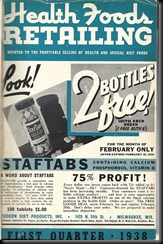
He was for many years editor of Health Foods Retailing, the health-food industry’s very first trade publication and the official magazine of the NPA for 50 years, from the late-1930s until the mid-1980s.
More Than One Slingshot
A bestselling health-book author, Frank has been one of the industry’s most articulate, enthusiastic and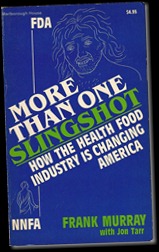 tireless crusaders, having stood arm-in-arm with Milton Bass, Max Huberman and NPA in successful opposition to the Vitamin Volstead Act from 1966 through 1976, when the Proxmire Vitamin Bill was signed into law.
His book, More Than One Slingshot, which was written for the association, tells the history of the health food industry from its origins in the late 1890s up through the early 1980s.
The book has this great, dated cover that I love, one which depicts David and Goliath, a popular representation of the battle between the health-food industry and the U.S. Food and Drug Administration (FDA).
Today, in early 2010, we face many of the same threats to health freedom even if the names of the bills and the players have changed.
Today’s Threats to Health Freedom
In March of 2009, Sen. Richard Durbin (D-IL) introduced S. 510, the Food Safety Modernization Act, a bill that would hand over extensive, unwarranted powers to an agency, the FDA, that has shown that it cannot objectively and properly fulfill its mission regarding dietary supplements since it constantly works to undermine the Dietary Supplement Health and Education Act of 1994 (DSHEA) through coordinated suppression of supplement companies and health information regarding products sold by legitimate manufacturers.
As this bill was reviled by consumers and farmers across the country, it appeared to fall by the wayside, that is until Sen. John McCain introduced S. 3002, the Dietary Supplement Safety Act of 2010.
Senate Bill 3002 was said to be about athletics ─ trying to protect athletes from spiked or doped supplements (although one would think the athletes would know what they were taking, especially if they themselves ordered these products from shifty chemists and fly-by-night pharmacists), but it included a whole host of anti-supplement provisions that almost made S. 510 pale by comparison.
A firestorm of consumer outrage ensued: many tens of thousands of letters were sent to the Senate thanks to powerful grassroots advocacy campaigns organized by Citizens for Health, the Alliance for Natural Health and the NPA. In early March, Sen. McCain decided to withdraw his support of the bill, with the caveat that certain provisions should be carried over to S. 510, most of which are already in S. 510 as it now stands.
Consumers, and the natural products industry, must be especially vigilant now and throughout 2010 ─ regarding S. 510 so that the bad provisions in this bill are dropped or drastically revised, and that nothing even worse from the dry-docked S. 3002 winds up being added to S. 510.
Tomorrow’s Health Freedom Opportunities
As to bills that offer a ray of hope, there are currently three main ones: H.R. 4913, H.R. 3394 and H.R. 3395.
On March 23rd, Rep. Jason Chaffetz (R-Utah) and Rep. Jared Polis (D-CO) introduced the Free Speech about Science Act (H.R. 4913); since then, Rep. Dan Burton (R-Indiana) has signed on as a co-sponsor. The bill allows producers of healthy foods and dietary supplements to cite legitimate scientific studies on the health benefits of their products.
 Similar in title to H.R. 4913, the Freedom of Health Speech Act (H.R. 3394), which was introduced by Rep. Ron Paul on July 29, 2009 and co-sponsored by Rep. Dan Burton and Dana Rohrabacher (R-Calif.), is geared to prevent the FTC from taking action against any advertiser that communicates a health benefit for a product unless the FTC first establishes, based on clear and convincing evidence, that the statement made is false and that its communication causes harm to the public.
 The Health Freedom Act (H.R. 3395) is designed to remove FDA's power of prior restraint over all nutrient-disease relationship claims.
According to Constitutional lawyer Jonathan Emord, under the bill “FDA may not prohibit any statement concerning a nutrient affecting a disease (including treatment effects) from being made in the market and may only act against a statement once made if it possesses clear and convincing evidence that the statement is false.”
Gormley Take-Away: The powerful advocacy campaigns against S. 3002 (which generated tens of thousands of letters), in addition to meetings and conference calls with Sen. McCain and his staff, effected a partial yet still very important victory. The momentum and informed action that allowed consumers and the natural products industry to achieve this win must be maintained so that objectionable provisions of S. 510 are removed or drastically revised. Other bills that offer opportunities for informed action should be kept on our radar screens, including H.R. 4913, H.R. 3394 and H.R. 3395.
[Courtesy of NOW Foods]
Consumers and the health-food industry may have stopped S. 3002 in its tracks, but S. 510 and other threats to health freedom remain. Nevertheless, a new slate of bills, along with a re-invigorated health-freedom movement, offer new hope for the future.
 Since the health-food movement’s earliest origins in New Hampshire in the 1790s, there have been many champions of health freedom.
 The one who immediately springs to mind, at least for me, is Frank Murray, who happened to be my first boss before I became editor of Better Nutrition magazine in 1995.
 In 2006, Frank was the recipient of the Natural Product Association (NPA) President’s Award for “long-time contributions to the natural products industry.”
 He was for many years editor of Health Foods Retailing, the health-food industry’s very first trade publication and the official magazine of the NPA for 50 years, from the late-1930s until the mid-1980s.
More Than One Slingshot
A bestselling health-book author, Frank has been one of the industry’s most articulate, enthusiastic and
 tireless crusaders, having stood arm-in-arm with Milton Bass, Max Huberman and NPA in successful opposition to the Vitamin Volstead Act from 1966 through 1976, when the Proxmire Vitamin Bill was signed into law.
 His book, More Than One Slingshot, which was written for the association, tells the history of the health food industry from its origins in the late 1890s up through the early 1980s.
The book has this great, dated cover that I love, one which depicts David and Goliath, a popular representation of the battle between the health-food industry and the U.S. Food and Drug Administration (FDA).
Today, in early 2010, we face many of the same threats to health freedom even if the names of the bills and the players have changed.
Today’s Threats to Health Freedom
In March of 2009, Sen. Richard Durbin (D-IL) introduced S. 510, the Food Safety Modernization Act, a bill that would hand over extensive, unwarranted powers to an agency, the FDA, that has shown that it cannot objectively and properly fulfill its mission regarding dietary supplements since it constantly works to undermine the Dietary Supplement Health and Education Act of 1994 (DSHEA) through coordinated suppression of supplement companies and health information regarding products sold by legitimate manufacturers.
As this bill was reviled by consumers and farmers across the country, it appeared to fall by the wayside, that is until Sen. John McCain introduced S. 3002, the Dietary Supplement Safety Act of 2010.
Senate Bill 3002 was said to be about athletics ─ trying to protect athletes from spiked or doped supplements (although one would think the athletes would know what they were taking, especially if they themselves ordered these products from shifty chemists and fly-by-night pharmacists), but it included a whole host of anti-supplement provisions that almost made S. 510 pale by comparison.
A firestorm of consumer outrage ensued: many tens of thousands of letters were sent to the Senate thanks to powerful grassroots advocacy campaigns organized by Citizens for Health, the Alliance for Natural Health and the NPA. In early March, Sen. McCain decided to withdraw his support of the bill, with the caveat that certain provisions should be carried over to S. 510, most of which are already in S. 510 as it now stands.
Consumers, and the natural products industry, must be especially vigilant now and throughout 2010 ─ regarding S. 510 so that the bad provisions in this bill are dropped or drastically revised, and that nothing even worse from the dry-docked S. 3002 winds up being added to S. 510.
Tomorrow’s Health Freedom Opportunities
As to bills that offer a ray of hope, there are currently three main ones: H.R. 4913, H.R. 3394 and H.R. 3395.
On March 23rd, Rep. Jason Chaffetz (R-Utah) and Rep. Jared Polis (D-CO) introduced the Free Speech about Science Act (H.R. 4913); since then, Rep. Dan Burton (R-Indiana) has signed on as a co-sponsor. The bill allows producers of healthy foods and dietary supplements to cite legitimate scientific studies on the health benefits of their products.
 Similar in title to H.R. 4913, the Freedom of Health Speech Act (H.R. 3394), which was introduced by Rep. Ron Paul on July 29, 2009 and co-sponsored by Rep. Dan Burton and Dana Rohrabacher (R-Calif.), is geared to prevent the FTC from taking action against any advertiser that communicates a health benefit for a product unless the FTC first establishes, based on clear and convincing evidence, that the statement made is false and that its communication causes harm to the public.
  The Health Freedom Act (H.R. 3395) is designed to remove FDA's power of prior restraint over all nutrient-disease relationship claims.
 According to Constitutional lawyer Jonathan Emord, under the bill “FDA may not prohibit any statement concerning a nutrient affecting a disease (including treatment effects) from being made in the market and may only act against a statement once made if it possesses clear and convincing evidence that the statement is false.”
Gormley Take-Away: The powerful advocacy campaigns against S. 3002 (which generated tens of thousands of letters), in addition to meetings and conference calls with Sen. McCain and his staff, effected a partial yet still very important victory. The momentum and informed action that allowed consumers and the natural products industry to achieve this win must be maintained so that objectionable provisions of S. 510 are removed or drastically revised. Other bills that offer opportunities for informed action should be kept on our radar screens, including H.R. 4913, H.R. 3394 and H.R. 3395.
Subscribe to:
Posts (Atom)


 Posts
Posts